

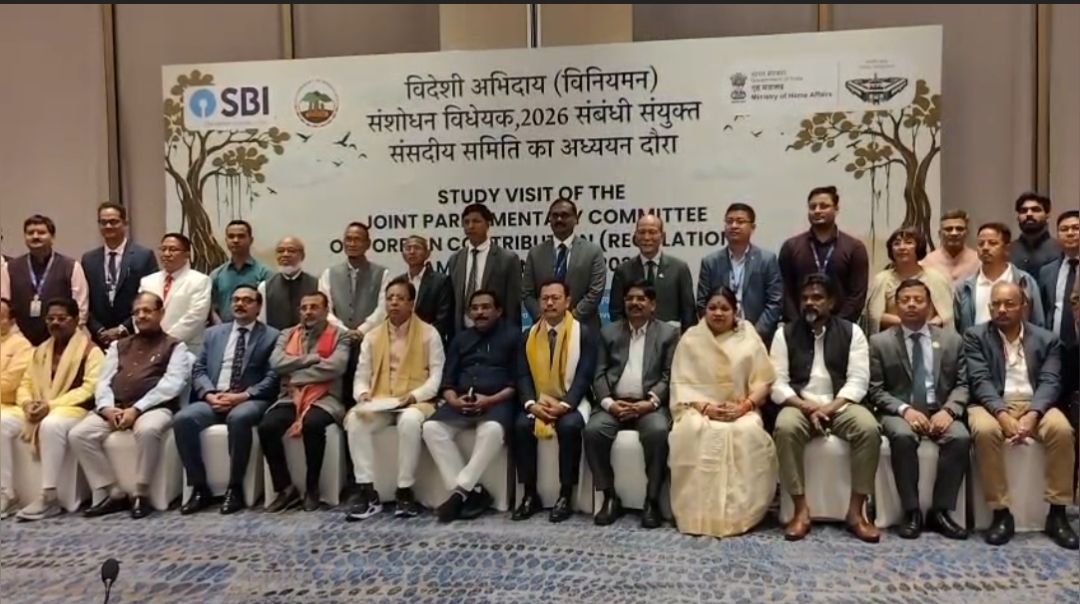
SHILLONG : Around 40 organisations from Meghalaya, Manipur, Nagaland and Assam appeared before the Joint Parliamentary Committee (JPC) on the Foreign Contribution (Regulation) Amendment Bill, 2026, during its first hearing outside New Delhi, held in Shillong on Monday.
The hearing was organised following a request by Meghalaya Chief Minister Conrad K Sangma, who had urged the committee to visit the state and hear the concerns of organisations receiving foreign contributions.
JPC Chairman Sanjay Jaiswal said the committee had carefully considered the suggestions put forward by the participating organisations and had sought further responses within 15 days.
“Chief Minister Conrad K Sangma specifically asked us to come to Meghalaya and listen to the problems of those groups having foreign contributions. We have taken note of each suggestion. They have given very nice suggestions and we have asked questions which they have to reply to within 15 days,” Jaiswal said.
He added that the committee would examine the responses before preparing the final draft of the Bill, with the objective of ensuring that the proposed legislation benefits all stakeholders.
Among those who deposed before the committee was the Archbishop of Guwahati. Jaiswal informed that around 84 organisations from across the country had expressed interest in presenting their views, including 40 from the North East, comprising non-governmental organisations (NGOs) and religious institutions.
However, he declined to disclose the specific recommendations made during the hearing, stating that the committee would first present the submissions to Parliament.
“In the JPC, we are not allowed to give suggestions to the public. First we will place before Parliament which organisation gave what suggestion,” he said.
The committee is scheduled to hold further consultations in Kochi and Chennai to understand the practical challenges faced by organisations at the ground level before finalising the proposed legislation.
Defending the proposed amendments, Jaiswal referred to the original FCRA Act enacted in 2010 during the UPA government’s tenure. He claimed that the earlier legislation gave vetting powers to state principal secretaries or home secretaries and also allowed the takeover of religious properties, including temples, churches and mosques, without objections being raised at the time.
He maintained that the present amendment Bill clearly provides protection to religious institutions.
“The present Bill clearly says temple, church or mosque should be maintained as it is, nobody can interfere,” he said.
Jaiswal also stated that only six per cent of foreign contributions received in the country went to religious organisations, while the remaining 94 per cent went to NGOs and other organisations, stressing the need for a comprehensive approach while framing the law.
Addressing concerns raised by smaller organisations over registration requirements, he said the committee was considering suggestions from all stakeholders to ensure that the legislation supports organisations working for social welfare while preventing activities that could threaten national security.
On the requirement of a designated State Bank of India account in New Delhi, Jaiswal clarified that the arrangement was intended only to facilitate the routing and tracking of foreign contributions, including details of their sources and senders. The funds could subsequently be transferred to any bank account anywhere in India.
He further stated that India receives approximately Rs 22,000 crore in foreign contributions annually and reiterated that political parties are prohibited from receiving foreign contributions.
Jaiswal described the Shillong hearing as the final consultation for the North East, adding that the committee had issued four weeks’ notice to organisations interested in presenting their views and had invited all those who expressed their willingness to participate.