

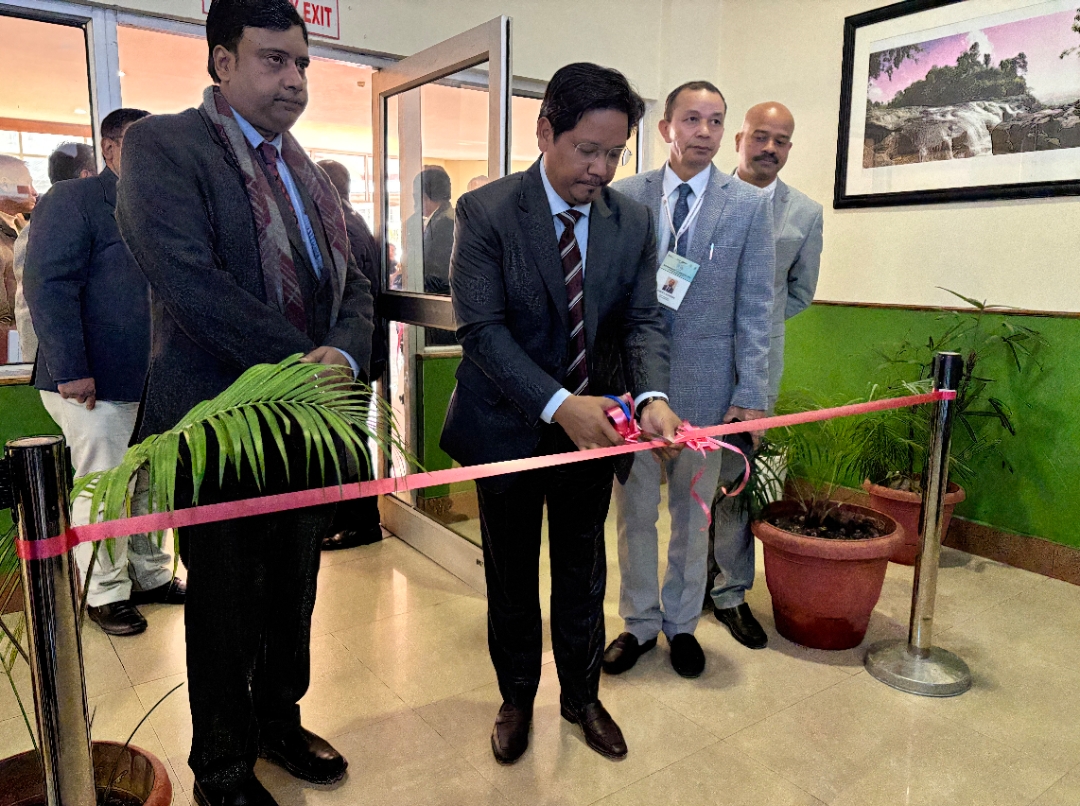
The Regional AI Impact Conference, Shillong, organised by the IndiaAI Mission, Ministry of Electronics and Information Technology (MeitY), Government of India, in collaboration with the Information Technology & Communications Department, Government of Meghalaya, was inaugurated today at the State Convention Centre, Shillong.
The event was graced by Shri. Conrad K. Sangma, Chief Minister of Meghalaya, as Chief Guest, and Shri. Ashwini Vaishnaw, Union Minister for Railways; Electronics & Information Technology; and Information & Broadcasting, addressed the inaugural session virtually and extended his greetings. Senior officials from MeitY, representatives from industry, academia, startups and students from across the region participated in the conference.
Delivering his inaugural address, Chief Minister Shri. Conrad K. Sangma highlighted Meghalaya’s progress in digital governance, AI adoption and the technology ecosystem. He outlined the State’s journey from the revival of the IT Park in 2018 to the development of the second phase and several upcoming IT infrastructure projects. He informed that global companies are now sourcing high-end solutions from Meghalaya, noting that a key module used in the global S/4 HANA Enterprise Resource Planning (ERP) migration sector—an industry valued at around USD 10 billion, where one of the modules to test the S4 HANA was developed in Shillong by a local engineer. “Even a ten percent share of this market has the potential to generate up to Rs 9,000 crore in business and create thousands of jobs for our young people,” he said.
Focusing on data-driven governance, the Chief Minister highlighted that Meghalaya, once recording the highest maternal mortality rate in the country in 2018, has reduced the figure by 50 percent. “Every pregnant woman is digitally tracked, enabling early identification of high-risk cases and timely interventions,” he said. He added that over 75,000 springs across the State have been digitally mapped using satellite, drone and other AI technologies to address water preservation. The Chief Minister also referred to an instance where data-based scientific assessments helped reduce the cost of a proposed water supply project from nearly Rs 100 crore to just Rs 4.5 crore.
He also stressed the importance of ecosystem development, including improving connectivity, strengthening hospitality infrastructure, supporting engineering education, and nurturing talent in emerging fields such as AI and quantum computing.
Referring to the Bhashini Hackathon for Khasi and Garo languages, he said it is an excellent model for engaging young minds and refining indigenous language modules. “For the youngsters, I truly hope all of you will see this as an opportunity and become partners in what we are trying to build,” he said. Emphasising the need for structured innovation platforms, he added, “Innovation will happen with competitions. That is why I started the Entrepreneurship Competition in 2018,” he said, calling for more innovation-based competitions led by the IT Department. He stressed that incentivising innovation is the most effective way to spark creativity, strengthen problem-solving skills and prepare the State to leapfrog in the ongoing technology race, while creating new opportunities for Meghalaya’s young population.
Addressing the gathering virtually, Union Minister Shri. Ashwini Vaishnaw reiterated that Prime Minister Shri Narendra Modi has given the nation a clear vision of democratising technology, ensuring equitable access to emerging tools and digital infrastructure. As part of this mission, the Government of India is organising regional AI Impact Conferences across the country, with the Shillong edition focused on the three pillars of People, Planet and Progress.
Highlighting the scale of national investment, the Minister informed that the Government has allocated Rs 10,300 crore over five years to build an inclusive AI ecosystem. A Common Compute Facility has been created to give universal access to high-end AI resources, with over 38,000 GPUs already onboarded at a fraction of global costs. He noted that 3,800 datasets and more than 250 open-source models have been made available to innovators and developers, enabling faster and more affordable AI-based application development.
The Minister added that India’s goal is to train one million people in AI skills, which will be a defining factor for employability in the future. He added that 570 Data & AI Labs are being established across the country, where one lab is set up at National Institute of Electronics & Information Technology, Shillong (NIELIT), and two more labs are to be established in Industrial Training Institute, (ITI) Shillong, and Shillong Polytechnic. A lab at ITI Tura is also on the pipeline.
Shri. Sampath Kumar, Principal Secretary, Government of Meghalaya, noted that the conference offers valuable opportunities for learning and collaboration in the field of artificial intelligence. He highlighted Meghalaya’s strategy for achieving the Chief Minister’s vision of positioning the State among the top 10 in the country in terms of development. He also shared about Meghalaya’s rich forest cover, nearly 75 percent of the State and the innovative measures being adopted to prevent deforestation. Collaborations with global research institutions, including Yale University, enabled predictive modelling of potential deforestation hotspots. This led to the introduction of the Payment for Ecosystem Services scheme, providing forest owners with an annual basic income to conserve forests. “This is the power of data, and how we can use it to protect our people and our environment,” he said.
Shri. Kumar added that with 51 percent of Meghalaya’s population below the age of 20, the State possesses a strong human capital advantage. He encouraged leveraging this youthful demographic to build an AI-driven economy and suggested that Meghalaya could emerge as an “AI Factory” alongside the region’s growing semiconductor ecosystem.
Shri. Sudeep Shrivastava, Joint Secretary, Ministry of Electronics & IT, stated that the IndiaAI Mission, launched in 2024 with an outlay of Rs 10,371 crore, aims to build an inclusive and robust AI ecosystem aligned with India’s developmental priorities. He outlined the Mission’s seven core pillars—IndiaAI Compute Infrastructure, IndiaAI Foundation Models, IndiaAI Datasets, Application Development, FutureSkills, Startup Financing, and Safe & Trusted AI, which together aim to make AI accessible, responsible and impactful.
Shri. Shrivastava noted that Meghalaya was chosen to host the first Regional Summit due to its leadership in digital governance. He commended initiatives such as MeghEA, paperless proceedings in the Meghalaya Legislative Assembly, and the State’s e-District service delivery model. He added that with 51 percent of Meghalaya’s population below 21, strong human resource capacity, favourable climatic conditions, and significant hydropower potential, the State is uniquely positioned to attract large investments in knowledge-based industries.
The programme commenced with technical sessions aligned with the objectives of the IndiaAI Mission. A series of initiatives and MoUs under the IndiaAI Mission were also launched, namely, Bhashini Hackathon for Khasi and Garo languages, Meghalaya Digital Ecosystem Enablement (MeghDEE), DRISHTI-NE Hackathon, in collaboration with IIM Shillong and MATH, MoU for setting up a Data & AI Lab with IndiaAI Mission and MoU for establishing a Satellite Incubation Centre with MATH T-Hub.