

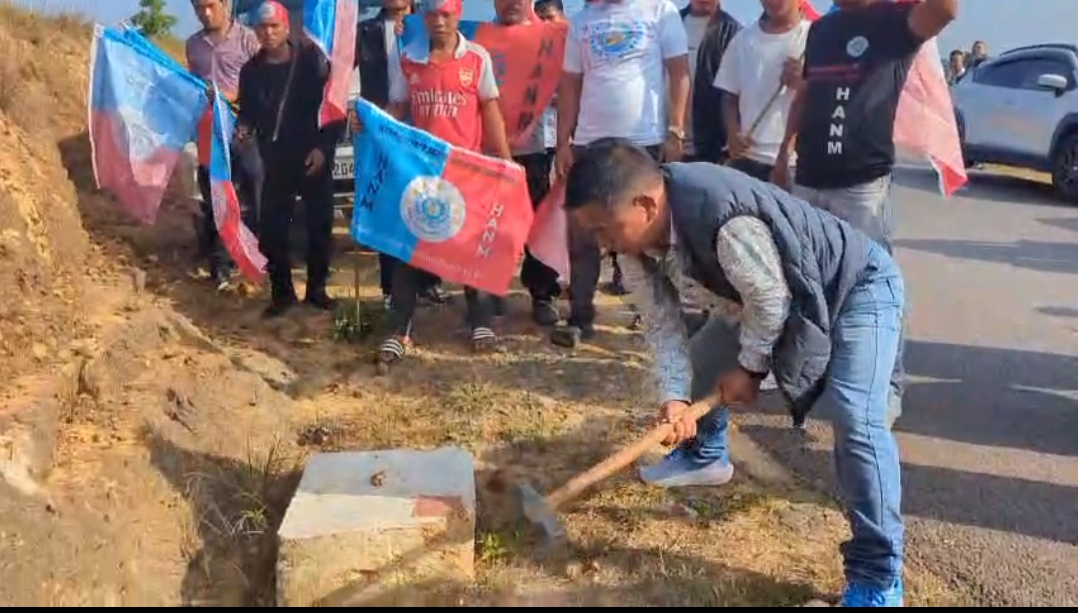
SHILLONG : The Hynniewtrep Achik National Movement (HANM) on Saturday dismantled a pillar erected by the Northeast Frontier Railway (NFR) at Lat Sohkymphor in East Jaintia Hills, opposing the proposed railway project and reiterating its demand for the implementation of the Inner Line Permit (ILP) before any railway construction is allowed in the Khasi-Jaintia Hills.
HANM president Lamphrang Kharbani, speaking after the action, issued a strong warning to both the Central and Meghalaya governments, stating that the organisation would not accept the railway project without adequate legal safeguards to protect the indigenous population.
“Give ILP first, then we can talk about the railway,” Kharbani asserted.
He expressed concern over the growing presence of outsiders in Meghalaya, claiming that the indigenous population was increasingly facing demographic pressure even in the absence of a railway connection.
Referring to population figures, Kharbani cited the Khasi and Garo populations and alleged that the changing demographic situation was threatening the identity of indigenous communities.
He pointed to places such as Lad Rymbai, Pynthor, Khyndai Lad and Shalang, claiming that the changing population composition had made it increasingly difficult to recognise these areas as traditional Hynniewtrep territories.
Kharbani maintained that the demand for ILP was fundamentally about protecting the identity, land and future of indigenous communities.
He cited the situation in Tripura as a warning, arguing that the indigenous population there had become marginalised in its own homeland.
“We do not want to become a minority in our own land,” he said, adding that unlike the Nagas and Mizos, who have their respective states to turn to, the Khasi-Jaintia people have no other homeland.
Warning that the organisation would continue opposing the railway project, Kharbani said HANM would dismantle railway infrastructure if construction proceeded without strong laws to safeguard the land and people.
“As long as we do not have ILP, the law to protect the land, and if you bring the railway, we will dismantle it,” he declared.
He said the organisation was concerned about the consequences future generations could face if railway connectivity was introduced without adequate safeguards against influx.
Kharbani also acknowledged that the railway project could bring economic benefits, including reduced transportation costs, cheaper goods and easier travel for students pursuing education outside the state.
However, he argued that these benefits could not outweigh what he described as the potential dangers to the indigenous population.
“Yes, we cannot deny that if there is a railway there are benefits. It will bring down the prices of goods and ease travel for students who go to study outside, but it brings danger, trouble and destruction for the generation to be born,” he said.
Reiterating HANM’s position, Kharbani said the organisation would not accept the railway project at Sohkymphor unless the government first introduced strong protective legislation, including the ILP.
“No ILP, No Railway,” he declared.