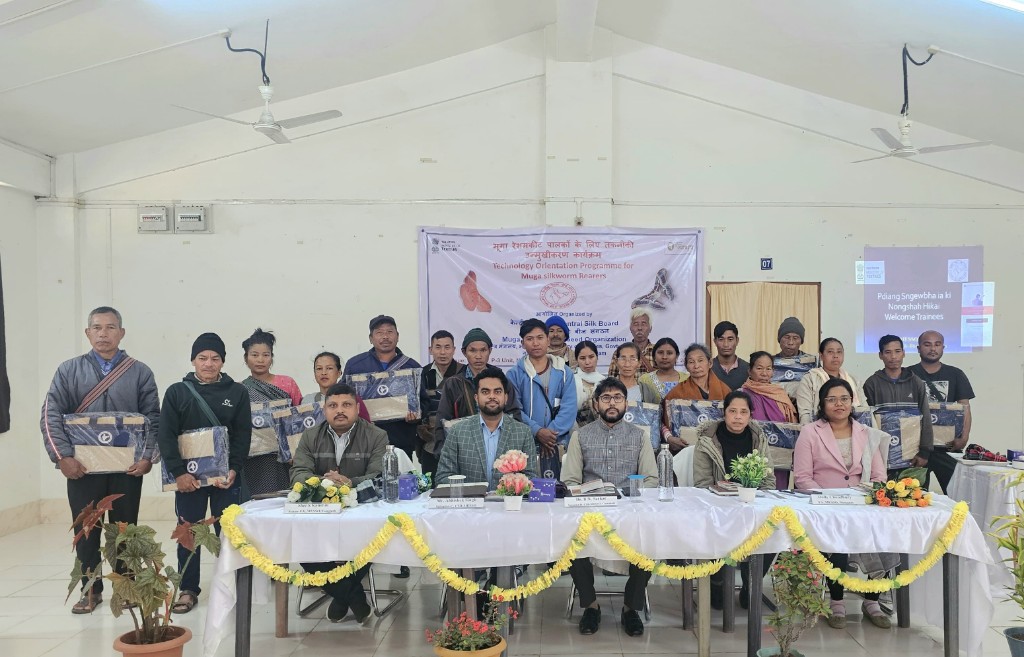
NONGPOH: A five-day Technology Orientation Training Programme on Muga Sericulture commenced on 19 January 2026 at the Central Silk Board (CSB), Muga Eri Silkworm Seed Organization (MESSO), P-3 Unit, Nongpoh, with the aim of strengthening technical capacity and sustainable practices among Muga silkworm rearers.
The training programme, scheduled from 19 January to 23 January 2026, is being attended by 25 progressive Muga sericulture farmers from Ri-Bhoi District. It focuses on enhancing farmers’ technical knowledge and practical skills through scientific training sessions, hands-on demonstrations, and expert interactions to improve Muga cocoon production in the region.
Participants are being trained on key aspects of Muga seed production, host plant management, disease and pest prevention, and scientific grainage techniques. The programme places special emphasis on adopting improved and sustainable practices to ensure better productivity, high-quality seed production, and long-term sustainability of the Muga silkworm industry, which is a vital source of livelihood for farmers in Meghalaya.
The inaugural session was held on 19 January 2026, during which Mr. Abhishek Singh, Scientist-C and In-charge of CSB P-3 Unit, Nongpoh, welcomed the participating farmers. In his address, he outlined the objectives of the training programme and highlighted the crucial role of the Central Silk Board in promoting sericulture development through capacity building and technology dissemination. He encouraged farmers to actively engage in the sessions and adopt scientific rearing methods in their practices.
The programme was formally inaugurated by Dr. B. N. Sarkar, Scientist-D, CSB-MESSO, Guwahati, who delivered an insightful lecture on the current status of the Muga silkworm industry. He highlighted the challenges faced by the sector and emphasized the need for improved rearing techniques, quality seed production, and scientific management to enhance productivity and farmers’ income.
Further, Mr. Abhishek Singh, Scientist-C, conducted technical sessions on Improved Muga Silkworm Rearing Technologies, covering seasonal management, disease control measures, and efficient utilization of host plants. He also discussed major challenges faced by Muga farmers and suggested practical, science-based solutions to overcome them.
An interactive session was also organised, during which farmers raised queries related to rearing problems, disease incidence, climatic challenges, and market prospects. Experts addressed these issues in detail, making the programme highly participatory and informative.
The training programme is expected to empower Muga farmers with advanced knowledge and skills, contributing significantly to the sustainable growth of the Muga sericulture industry in Ri-Bhoi District and Meghalaya as a whole.