

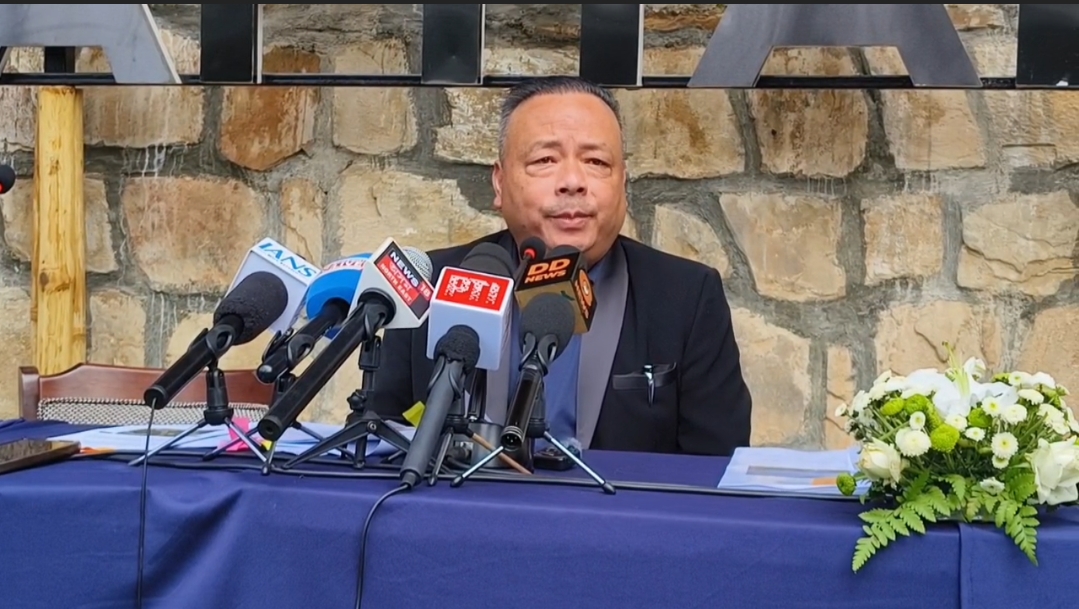
SHILLONG : Meghalaya Tourism Minister Paul Lyngdoh on Thursday made it clear that the proposed Shillong Peak Ropeway Project would proceed, asserting that the government had secured all necessary clearances and that a binding 30-year land lease agreement had already been signed with the Riat Laban Dorbar Pyllun.
Speaking to reporters after taking charge of the Tourism Department following his re-induction into the Cabinet, Lyngdoh said the government possessed all relevant documents, approvals and records to establish the legality of the project.
He said his immediate priority was to address the concerns and doubts surrounding the ropeway project and clarify the government’s position.
Displaying a map prepared by the Public Health Engineering (PHE) Department, Lyngdoh maintained that no section of the proposed ropeway alignment from Terminal 1 onwards was located near any water source or stream.
According to him, the disturbance in the area was largely associated with the construction of houses near streams and water bodies.
Responding to allegations that the project would encroach upon the sacred peak of Lei Shyllong, the Tourism Minister said the project site was located 3.15 kilometres away from Shillong Peak.
Lyngdoh said the idea of developing a ropeway to the Shillong viewpoint was first discussed in the 1980s, following complaints from visitors about identity checks, restricted entry and closed gates at the viewpoint.
He said the project was conceived to provide easier and more accessible entry to visitors, with the proposed ropeway expected to take only three minutes to travel from Terminal 1 to the viewpoint.
On the project’s legal and administrative status, Lyngdoh said all necessary clearances from various ministries of the Government of India had been obtained, along with No Objection Certificates (NOCs) from the Airports Authority of India, the Indian Air Force and the Army.
He further stated that written clearances from local dorbars dated back to 2022, while the land lease agreement with the Riat Laban Dorbar Pyllun, comprising seven dorbar shnongs, was signed on January 16, 2023.
Land for compensatory plantation was subsequently transferred in September 2023.
Pointing to the timeline of the agreement, Lyngdoh said objections to the project had surfaced only last year, despite the agreement having been signed in January 2023.
He argued that the government could not simply reverse the decision after entering into a 30-year agreement, adding that there was no cooling-off period under the agreement.
The minister also rejected allegations that consultations with residents had been inadequate, saying several rounds of discussions had taken place before the agreement was signed.
He said the concerned dorbars had used public address systems to invite residents to the meetings, although attendance was reportedly poor. He added that the land involved was community land and did not include privately owned land.
Lyngdoh questioned why the authority of the dorbars was being challenged now, pointing out that the same local institutions had been elected by the residents who were currently opposing the project.
Defending the environmental aspects of the ropeway, he referred to an Environment Ministry notification dated April 27, 2022, which recommended excluding aerial ropeways from the Environmental Impact Assessment (EIA) Notification, 2006, citing their comparatively lower environmental impact than roads and highways.
The Tourism Minister also questioned the stand taken by groups opposing the project, particularly Greentech, referring to its earlier opposition to temporary structures at Lumphongdeng while, according to him, remaining silent over a permanent boathouse leased by MeECL since 2008.
He further claimed that during Wednesday’s engagement, opponents had failed to clearly explain their objections and repeatedly maintained that they were simply against the project.
Referring to the inauguration of the project by the President of India, Lyngdoh said the Rashtrapati Bhavan would have undertaken the necessary due diligence before associating the office of the President with the project.
Asked whether political interests were influencing the opposition, the minister said he could not rule out the possibility, particularly with the 2028 Assembly elections approaching.
Warning against prolonged opposition to development projects, Lyngdoh said such resistance could damage Meghalaya’s image as an investment destination and discourage government agencies, private investors and other organisations from undertaking projects in the state.
He cautioned that the consequences could extend far beyond the next Assembly elections, affecting Meghalaya’s development prospects for decades.
Lyngdoh questioned why investors would choose to invest in a state where projects could face opposition even four years after agreements had been signed.