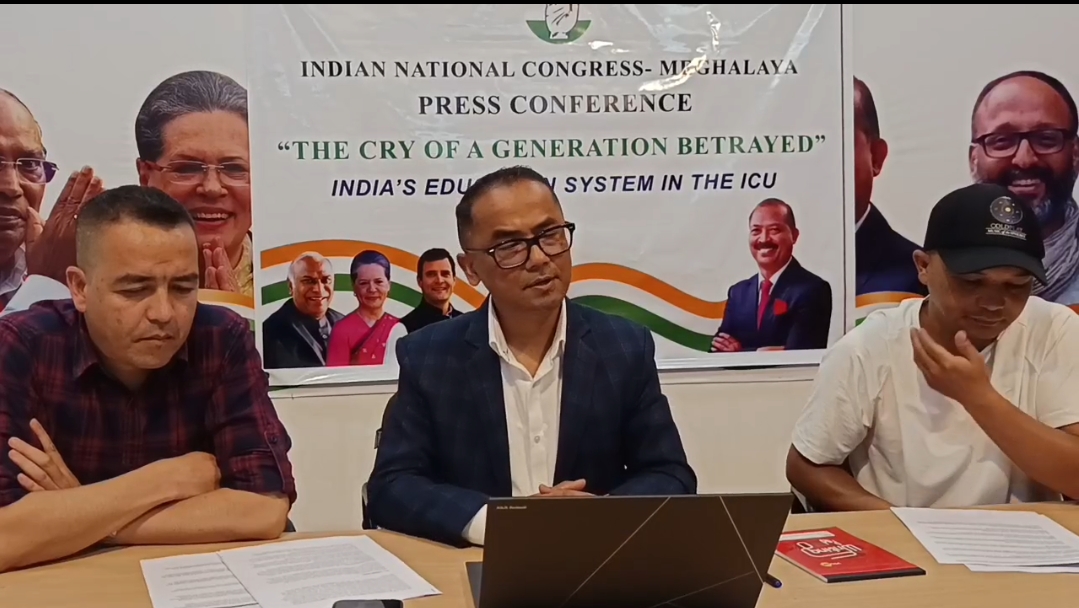
Shillong : Meghalaya Pradesh Congress Committee (MPCC) Chairman In-charge Social Media, Langkupar War, on Thursday alleged that Meghalaya is facing a disproportionate impact from India’s education crisis, with students in the state suffering the consequences of examination failures, funding shortages and weak educational infrastructure.
Referring to the NEET-UG 2026 controversy, War said over 4,100 students from Meghalaya were forced to reappear for the examination across 14 centres, highlighting what he described as deeper structural problems within the country’s education system.
According to War, the cancellation and re-conduct of NEET-UG 2026 exposed serious flaws in the examination process and further weakened public confidence in national testing agencies.
He criticized the National Testing Agency (NTA), citing controversies surrounding NEET-UG, UGC-NET and CUET examinations in recent years. He also questioned the effectiveness of the Public Examinations (Prevention of Unfair Means) Act, 2024, arguing that paper leak incidents continue despite stricter laws.
The Congress leader further claimed that increasing centralisation of education has reduced accountability while placing states at a disadvantage. He pointed to funding disputes affecting Samagra Shiksha and warned that underfunding of public education is forcing families to rely heavily on expensive coaching institutes and private loans.
War also expressed concern over the discontinuation of several scholarship programmes for minority students, saying the move has adversely affected economically weaker sections, including students in Meghalaya.
Highlighting the shortage of teachers across the country, he cited parliamentary data showing more than 8.46 lakh vacant teaching posts, which he said contribute to overcrowded classrooms, learning gaps and higher dropout rates, especially in rural and tribal areas.
With NEET expected to shift to a computer-based format from 2027, War warned that Meghalaya’s limited access to computers and internet facilities could place students at a significant disadvantage compared to their counterparts in other states.
He also pointed to concerns in higher education, including reduced allocations, faculty shortages and rising education costs, arguing that many students are being pushed towards private loans to pursue their studies.
Concluding his remarks, War said the current education system places excessive emphasis on examinations while neglecting practical skills and quality learning outcomes, leaving students to compete for limited opportunities in both education and employment.