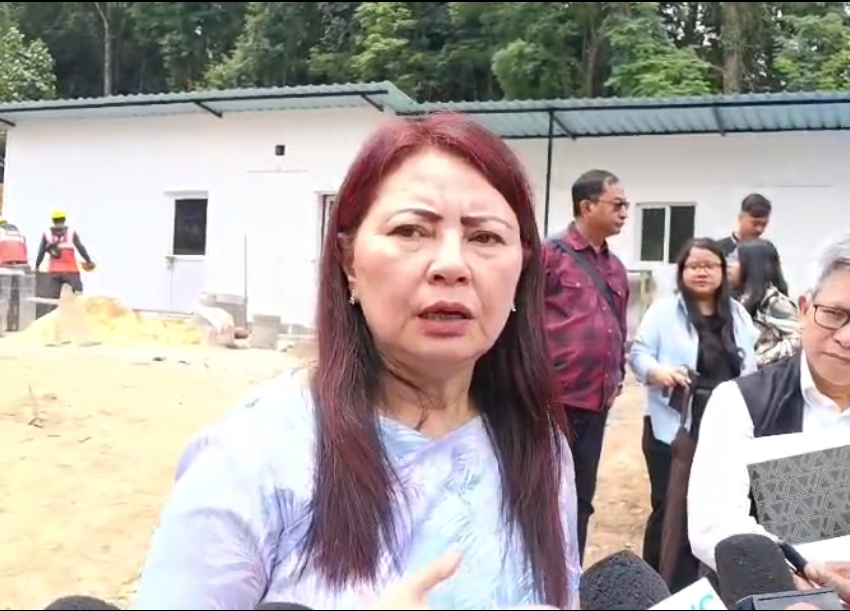
SHILLONG : The Meghalaya Government has said that the proposed Shillong Ropeway project will not affect water sources or the environment, following a joint inspection involving officials from the Public Health Engineering (PHE) Department, Forest Department, Shillong Municipal Board and the Raid Laban Dorbar Pyllun.
Joint Secretary In-Charge of Tourism, R.M. Kurbah, said concerns regarding water sources along the proposed ropeway alignment had been addressed during the inspection.
According to Kurbah, the identified water source is located towards Lawsohtun, beyond Nepali School, while the approximately 800-metre stretch covered by the project does not have any water sources.
“The water source is ahead towards Lawsohtun, beyond Nepali School. This 800-metre stretch has no water sources,” she said.
Ropeway design revised to reduce impact on trees
Kurbah said the initial Detailed Project Report (DPR) had proposed cables at a height of around 25 metres. This, she said, could have required trees to be cut across the channel.
Following concerns over the environmental impact, the department asked for the height of the cables and towers to be increased.
“We asked for the cable and tower height to be raised. The new DPR provides about 40 metres of clearance,” Kurbah said.
She said tree felling has been restricted to the six proposed tower station locations, each measuring approximately 12 metres by 12 metres.
According to the Tourism Department, 544 trees were felled at the tower locations, all within forest land. The department said compensatory plantation has been undertaken on government land in accordance with the prescribed norms.
“As per 1:10 norms, we have planted 5,044 trees on government land,” Kurbah said.
Government says project will improve Shillong’s landscape
Kurbah also said the ropeway project would contribute to the beautification of Shillong and enhance the city’s landscape.
“This project is not affecting water or the environment. In fact, it will add to the beautification of this place. It is very important for the state,” she said.
She cited the urban ropeway project in Sikkim as an example of how such infrastructure could contribute to urban tourism.
On concerns regarding slope stability, Kurbah said restoration work would be undertaken, while the Forest Department would oversee greenery in areas where vegetation has been cleared.
She also appealed to members of the public to approach the Tourism Department with any concerns or seek clarification regarding the project.
“We appeal to people to come to the department for any clarification. If it is affecting you or anybody, we will address it,” she said.
Project contractor says environmental norms being followed
KEC-TCL Project Head J.P. Singh said environmental protection remains one of the major considerations during execution of the project.
“The main challenges for any ropeway are material transportation and protecting the local ecology. We will ensure nothing goes against the environment,” Singh said.
The government maintains that the revised design and mitigation measures will minimise the project’s impact on the environment while allowing the Shillong Ropeway to proceed as a major tourism and urban transport infrastructure project.